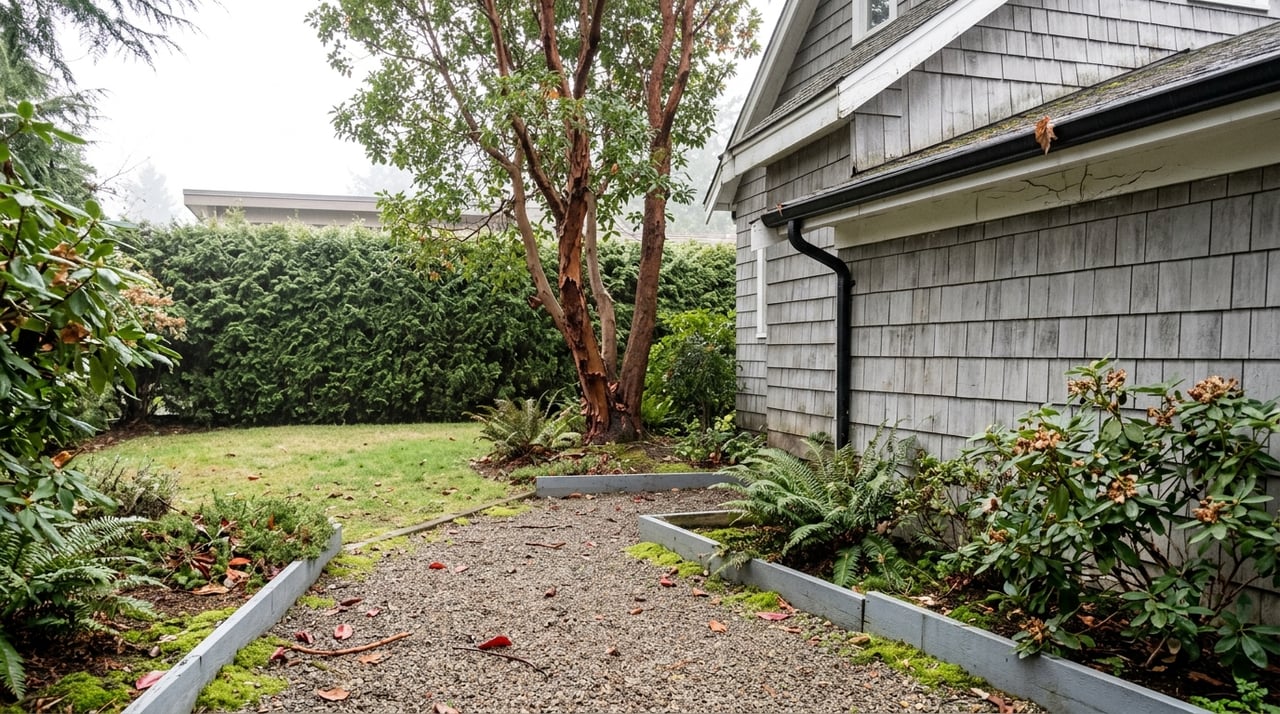
A six-bedroom character home at 121 Harewood Road hit the market in early August 2026 for $814,900. Built in 1920, sitting on a 8,058-square-foot lot, it is the kind of property that would comfortably clear a million dollars in the neighbourhoods north of downtown. In South Nanaimo, it lists just under the city's own single-family benchmark, which stood at $822,200 as of July 2026 according to Vancouver Island Real Estate Board figures.
Ask most buyers why South Nanaimo trades below the rest of the city and you'll hear some version of the same story: it's Harewood, it has a reputation, give it time. That story is incomplete. Sales activity in South Nanaimo isn't soft. What's happening is a supply timing problem, and it's one that anyone comparing neighbourhoods this year should understand before they price a purchase or a rental investment off last year's assumptions.
The Sales Numbers Don't Support the Reputation Story
If demand were the issue, South Nanaimo's sales count would show it. It doesn't. From January through June 2026, South Nanaimo recorded 50 single-family sales, tied with Departure Bay and trailing only North Nanaimo's 115. That's not a neighbourhood buyers are avoiding. That's a neighbourhood absorbing a lot of transaction volume relative to its size, at prices below the city average.
When a neighbourhood sells at volume but under benchmark, the more useful question isn't "why don't people want to live there," it's "what's coming onto the market that's holding the price down." In South Nanaimo, the answer is concrete, and it has a name and a unit count.
Where the New Supply Is Actually Going
Over the past several years, Nanaimo council has approved a cluster of multi-family projects concentrated almost entirely in Harewood. A rezoning application for more than 200 townhouses at 560 and 604 Fourth Street and 361 Howard Avenue went to a public hearing, with the applicant, Howard Avenue Projects Ltd., proposing 219 strata units. The city's director of development approvals, Jeremy Holm, told council at the time that townhouses are a form of housing that is in demand.
Separately, council approved a 168-unit townhouse development on Watfield Road, consisting of 22 three-storey buildings and an amenity building. Holm noted that through the rezoning process, the applicant committed to at least 50 per cent family-friendly housing. Mayor Leonard Krog estimated the completed project could house roughly 525 people once you account for the three and four-bedroom units.
A third project, a six-storey, wood-framed rental building at Nicol and Needham streets, added another 127 units to the pipeline, all market rental, with a mix of unit types. Architect Morgan Burt described it during the council review as a six-storey, wood-framed project over a two-level concrete parking structure.
Add it up and you get more than 500 new housing units approved for a single stretch of one Nanaimo neighbourhood in the space of a few years. That is a meaningful share of the city's total housing pipeline landing in one place, and it changes how comparable sales behave. New multi-family stock at various price points pulls the neighbourhood's blended pricing down even while individual character homes, like the one on Harewood Road, hold their own value.
| Project | Units | Location |
|---|---|---|
| Howard Avenue townhouses | 219 | Fourth St. & Howard Ave. |
| Watfield Road townhouses | 168 | Watfield Rd. |
| Nicol/Needham rental building | 127 | Nicol St. at Needham St. |
This is the mechanism the reputation story misses. South Nanaimo isn't cheap because people don't want it. It's priced the way a neighbourhood prices when a large share of the city's new housing supply is being built there at once.
The VIU Wrinkle Investors Should Be Watching
There's a second supply shift underway, and it's easy to miss if you're only tracking neighbourhood sales stats. Vancouver Island University began construction on a new 266-bed student residence, with the province confirming the project broke ground in a January 2025 announcement. The building is a mass-timber structure, ten storeys including a concrete podium, funded with $87 million in provincial money as part of a broader plan to add thousands of student housing beds across B.C. Given the scale of a ten-storey mass-timber build, the beds are still working their way toward opening, which means the demand shift described below is only starting to show up in Harewood's rental market now.
The residence includes a 200-seat dining hall, study rooms, and shared kitchens, and it connects to a geo-exchange heating system that draws on water from the flooded, abandoned Wakesiah coal mine beneath campus. That detail matters less for buyers than what the beds themselves represent.
"We're working to build the student housing they need, while also easing pressure on local rental markets."
That's the framing from Minister of Infrastructure Bowinn Ma at the announcement, and it's worth taking seriously if you own or are considering a rental property near VIU. Harewood has functioned for years as an informal extension of campus housing, with off-campus rentals absorbing students who couldn't get a spot in residence. Add 266 new on-campus beds and some of that demand shifts back to campus. It won't empty out Harewood's rental market overnight, but it's a real variable that anyone running rental projections on a Harewood property should factor in rather than assume away.
Why the Housing Stock Looks the Way It Does
Part of what makes South Nanaimo's mix of old character homes and new townhouse blocks make sense is its origin. The Harewood Coal Mining Company was established in 1864 to work coal deposits south of Nanaimo, and by 1884 Samuel Robins, superintendent of the Vancouver Coal Mining and Land Company, had purchased the Harewood Estates and subdivided them into five-acre homestead lots for miners who wanted to farm alongside their shift work. For much of the twentieth century, Harewood sat outside Nanaimo's municipal boundary entirely, governed through its own improvement district until the province folded it into the city in 1975.
That history explains why a property like the one on Harewood Road, built in 1920 on a large lot, sits a few blocks from brand new three-storey townhouse construction. The neighbourhood was never built out as a single planned subdivision the way parts of North Nanaimo were. It grew in layers, and it's still growing in layers, just with 2026's version of density instead of 1920's version of a homestead lot.
What This Means If You're Comparing Neighbourhoods Right Now
If you're weighing South Nanaimo against North Nanaimo or Departure Bay on price alone, the numbers can look like a straightforward discount. They aren't, quite. A few things worth carrying into that comparison:
- The price gap reflects an active construction pipeline, not weak demand. Sales volume backs that up directly.
- Character homes on larger, older Harewood lots are not competing in the same pricing tier as the new townhouse product going up around them, even though both get counted in the same neighbourhood average.
- Anyone evaluating rental income near VIU should build the new 266-bed residence into their vacancy assumptions rather than pricing purely off the last few years of off-campus demand.
- As the approved multi-family projects finish absorbing into the market, the blended pricing gap between South Nanaimo and the rest of the city is more likely to narrow than persist indefinitely.
None of this means South Nanaimo is a bargain waiting to be discovered or a risk to avoid. It means the discount has a mechanical explanation with a rough timeline attached to it, which is more useful than a reputation story with no expiry date.
FAQ
Is South Nanaimo a good place to buy right now? It depends on what you're buying. A character home on a large lot is a different asset than a new-build townhouse, even though both trade under the "South Nanaimo" label. The neighbourhood's sales volume shows real demand, and the price gap versus the city benchmark reflects an active supply pipeline more than anything about desirability.
Will VIU's new student housing hurt Harewood's rental market? It's a variable, not a verdict. Two hundred and sixty-six new on-campus beds will pull some student renters away from off-campus housing near campus, including in Harewood. It's worth factoring into any rental income projection for a VIU-adjacent property, particularly if your existing tenant base skews toward first and second-year students who are the primary target for the new residence.
If you're trying to figure out what a specific South Nanaimo property is actually worth against this backdrop, or how the Harewood pipeline might affect your timeline to sell or buy, the Charlie Parker Team can walk through the comparables and the pipeline with you street by street. Contact us when you're ready to talk specifics.